. .
SATURDAY
NOVEMBER 30 - 2019
Langstone
Mill Pond
Peter
Milinets-Raby reports . . .
I visited Langstone Mill Pond this morning for a
couple of hours from 8:154am - low tide, but slowly
coming in. Grey and cloudy with a chance of
sandwiches.
Off shore on the Sweare Deep mud (Everything counted
for Solent Aware).
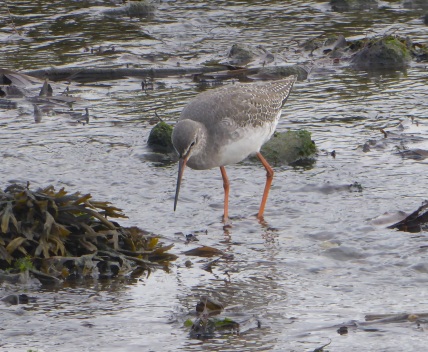
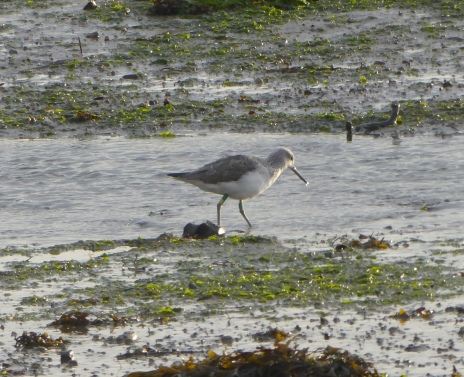
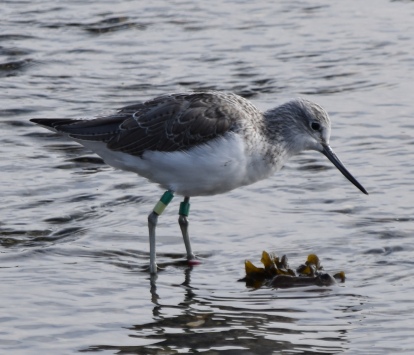
Greenshank (one in the stream - no rings - acts a bit
like the old ringed bird. Other was a colour ringed
bird RG//- + YY//-). 38 Teal, 2 Little Egrets, 3
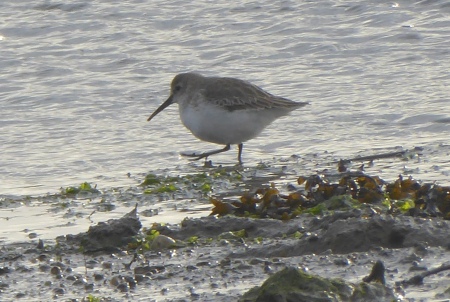
Moorhen, 220 Brent Geese, 11 Grey Plover, 296 Dunlin,
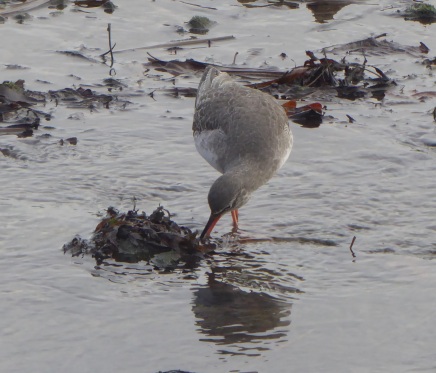
78 Shelduck, 3 Wigeon, 31 Redshank, 2 Common Gull, 8
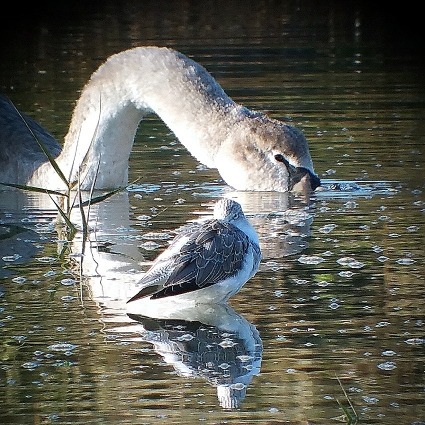
Mute Swan (The usual family, plus a straggler, who was
not welcome). Chased off the pond by the two adults
and the juvenile decided to look forlorn for itself on
the pathway by the pond (See photo).

4 Great Crested Grebe.
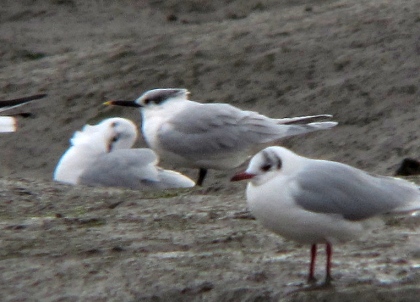
1 adult winter Med Gull. 5 Red Breasted Merganser, 10
Bar-tailed Godwit, 35 Oystercatchers, 7 Curlew, A male
Goldeneye, 3 Sandwich Terns (see photo),
4 Black-tailed Godwit,
16 Lapwing, And a male Kingfisher on the post by the
outlet stream. On the pond were 40+ Mallard, a Teal
and a female Tufted Duck.
Kingfishers
Christopher
Evans got some great photos of Kingfishers at Hayling
Oysterbeds. A good spot to see them perched! Here is a
handsome male showing off its fine plumage.

FRIDAY
NOVEMBER 29 - 2019
Nore
Barn
The tide was
already well advanced by the time I arrived at Nore
Barn this morning. As a result there were relatively
few birds to be seen apart from Brent Geese in the
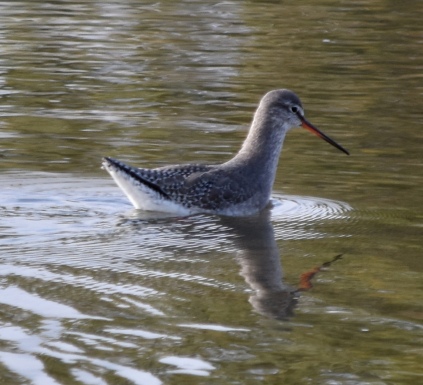
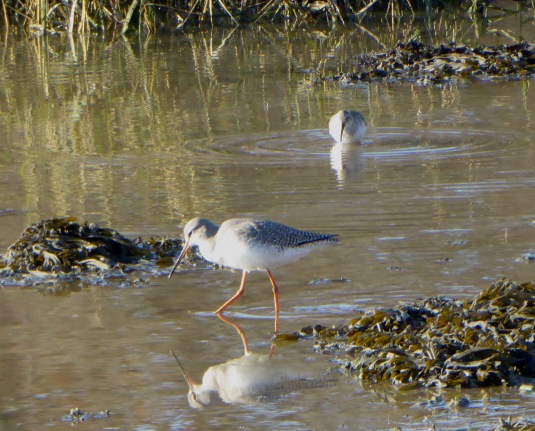
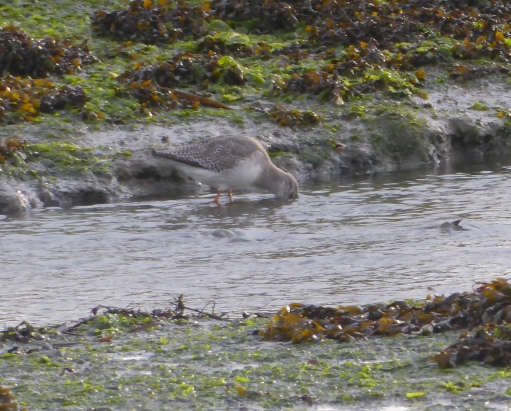
harbour and, of course, the one and only Spotted
Redshank feeding in the stream with just a single
Dunlin for company. The sun was too bright off the sea
for decent photos, but here's the best I got.
Bird
Aware Solent Event
Emily Jupe (a
Bird Aware Solent Ranger) e-mailed me to say that Bird
Aware Solent will be running a 2 hour pop-up event at
Nore Barn on Monday 2nd December at 11am-1pm.
Emily says this is part of their Great Solent Bird
Watch week, a citizen science project which aims to
raise awareness of the incredible birds that travel to
the Solent every winter.
Please come along and support this worthy cause. More
details are on the links below:
https://solent.birdaware.org/article/32052/The-Great-Solent-Birdwatch
http://facebook.com/events/2169430420029258/?ti=cl
THURSDAY
NOVEMBER 28 - 2019
Emsworth
Harbour
Peter
Milinets-Raby reports on today's visit to Nore Barn
and Emsworth Harbour . . .
Some
dry conditions. Yippee! Though probably too sunny,
with the sun in the wrong place causing an awkward
glare off the water!! Just no pleasing me!!
Nore Barn at 9:10am. The weather was perfect,
the tide state perfect (About 2 to 3 hours from high)
and the birds were perfect. In the stream were the
usual gang, consisting of Spotted Redshank, colour
Ringed Greenshank, a single Redshank, plus a single
Dunlin. Elsewhere at Nore Barn were 79 Black-tailed
Godwit, 67 Dunlin, a single Grey Plover, 139 Wigeon,
37 Teal, 151 Brent Geese and 2 Turnstone.
Beacon Square from 9:45am:251 Dunlin, 43
Wigeon, 288 Brent Geese, 3 Shelduck, a single Grey
Plover, 2 Sandwich Terns flying east, a Great Crested
Grebe and a Red Breasted Merganser.
Emsworth Harbour: Nearly high tide from 10am
until 10:45am.123 Brent Geese, 6 Little Grebes, 3
Common Gulls, a single Kingfisher dashing across the
harbour, 8 Red breasted Mergansers, a single Great
Crested Grebe, 18 Turnstone roosting on the buoys and
a Peregrine perched on the red channel marker.
However, the bird of the day drifted up the Emsworth
channel, close to Thorney Island with the small
flotilla of 8 Mergansers. It was very distant and just
a silhouette in the scope on 60x magnification for the
whole time and was not correctly identified UNTIL it
flew west into the sea area off Beacon Square where
the still distant views were only partly in
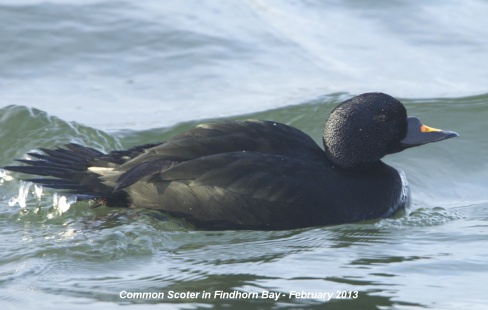
silhouette. The bird was a female Common
Scoter (only the second one I have seen in
the area) and it started to dive for food close to the
Sea Marsh, so very distant views indeed. A great
bird.
Brian's note:
Common Scoters are seen from time to time in winter
around the south coast. The Hampshire Bird Report
describes them as moderately common passage migrants,
but scarce in summer and winter. I personally have not
seen one for many years. Peter occasionally sees them
off Langstone - e.g. 3 males were seen on Oct 14 2013
and a female on 4 Dec 2016. More recently, Pete Potts
reported (on HOS) a female Common Scoter off Hayling
Oysterbeds on 23 Nov which could have been the same
bird as seen today by our Peter. The only Common
Scoter photo I have in my files is a male bird taken
by Richard Somerscocks in Feb 2013 after he moved to
Findhorn in Scotland.
WEDNESDAY
NOVEMBER 27 - 2019
Langstone
Mill Pond
Peter
Milinets-Raby reports . . .
I managed a poor 30 minutes this morning at Langstone
Mill Pond before the rain marched in. I was on site
from 9:10am with the tide nearly in.
Off shore in the last square inches of salt marsh and
mud were 297 Brent Geese, 35 Wigeon, 2 Teal, 9
Shelduck and on the last bits of dry Marsh were 36
Lapwing, 36 Grey Plover, 60+Dunlin, 6 Black-tailed
Godwit, 1 Turnstone and a winter plumaged Sandwich
Tern.
Out in the channel were 8 Red breasted Mergansers.
Nothing on the pond except the usual 30+ Mallard and
the Mute Swan family.
In the flooded horse paddock were 58 Teal and a single
Black-tailed Godwit.
MONDAY
NOVEMBER 25 - 2019
Langstone
Mill Pond
Peter
Milinets-Raby reports . . .
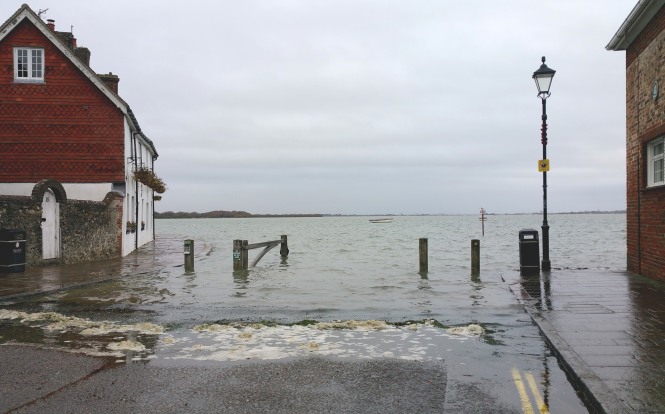
I had a 45 minute visit to Langstone-Mill-Pond in
The-Very -Fine-Drizzle this morning from 9:04am. Not
quite a 5 metre high tide, but still very impressive
and it must be a worry for the people who live in the
area. Not many birds to be seen.
After several scans of
the high tide waters I managed to find 3 Great Crested
Grebes, 9 Red breasted Mergansers and 30 Wigeon. Very
little on the pond, just 3 Teal, 2 Little Egrets, a
Grey Heron and a female Tufted Duck. All the Teal were
in the flooded horse paddock where I counted 72 of
them.
FRIDAY
NOVEMBER 22 - 2019
Call
Ducks on Baffins Pond
Eric Eddles keeps a beady eye out for anything unusual
on Baffins Pond in Portsmouth. Today he managed to see
a Call Duck which he has heard calling for a few days.
He thinks there may be two on the pond. In fact, Eric
has been seeing and hearing these unusual ducks for
several years on Baffins Pond, sometimes up to 10 in
number. Here is Eric's photo of the one he saw today.
Looks like a male as females tend to be much paler.

Here's a shot I got of
a couple of females on Baffins Pond in 2012.
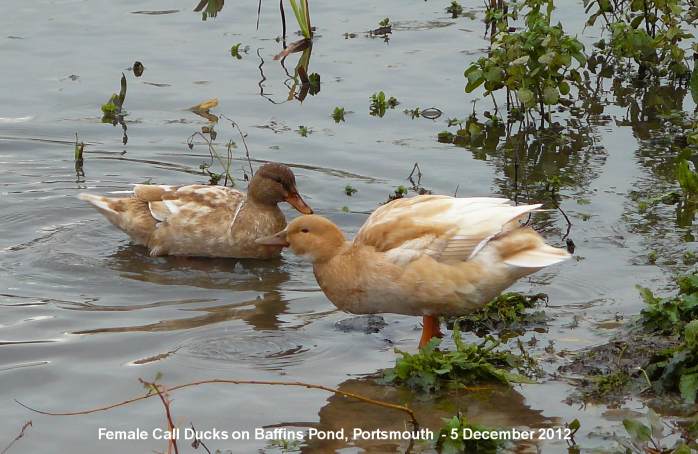
The Call Duck is a
very small breed of domesticated duck now raised
primarily for competition showing or as pets. They
look similar to Mallards, but are smaller in size.
They were initially used in the Netherlands in hunting
as decoys as their loud high pitched calls would
attract wild ducks towards the hunter's guns. This
practice has been replaced by artificial calls.
Eric also notes that
the Shovelers have been back on Baffins Pond
for a few weeks. Baffins is probably the best place in
the local area to see Shovelers. The most I ever
counted on Baffins Pond was 72, but Bob Chapman holds
the record of 83 on 22nd November 2001. I think
numbers have fallen considerably since then.
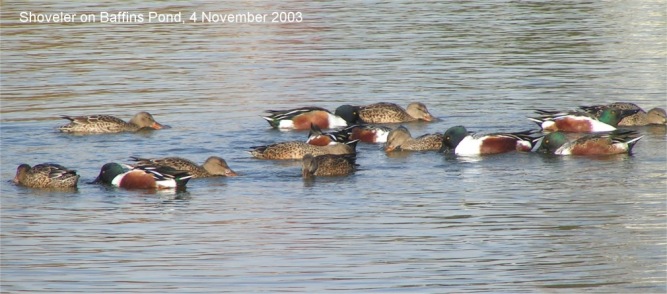
Shovelers have a distinctive circling round and round
feeding behaviour. Here is a shot I got of some males
and females indulging in this unusual bahaviour.
For a summary of my
birdwatching at Baffins Pond see . . .
Baffins
Pond
Sparrowhawk
in garden
Peter
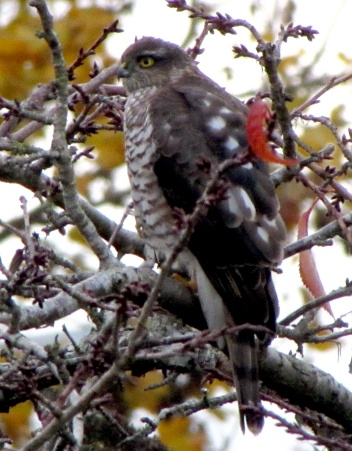
Milinets-Raby reports a Sparrowhawk dashed low across
his Havant garden and landed in next doors Pear Tree.
Peter used the six foot high fence as a hide and just
stuck the camera peeking over the top. Here is one
nice shot that Peter got. From the pale patches on the
wings this looks like a juvenile.
THURSDAY
NOVEMBER 21 - 2019
Brook
Meadow workday
Today's
session attracted 11 volunteers on a cold and dull
November morning, led by Reg Newnham.
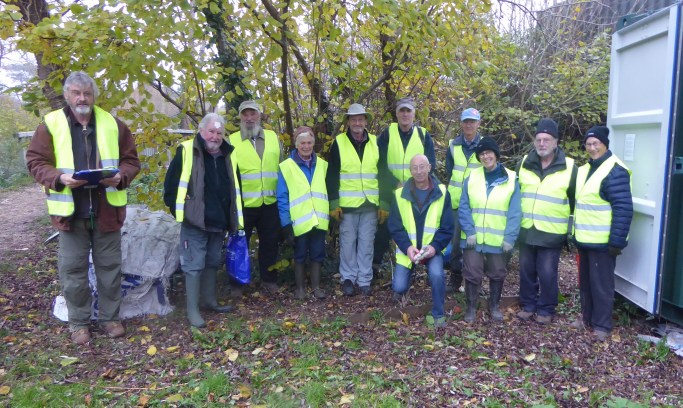
The main task was to
clear away the cut arisings from the Lumley
area

Another task was to
continue clearing the area around the Cherry trees by
Frank's seat in preparation for the school's Xmas
event being organised by Dan.

The only wildlife
interest I noted was lots of fresh molehills.
This is a active season for moles when tunnel systems
are being enlarged in preparation for the breeding
season. The tunnel system, which is the permanent
habitation of the mole, also acts as a food trap,
constantly collecting invertebrate prey such as
earthworms and insect larvae. As they move through the
soil, invertebrates fall into the mole run and often
do not escape before being detected by the patrolling
resident. If you watch carefully, you can sometimes
detect the hill being built as the mole pushes soil to
the surface. Moles are rarely seen on the surface of
the ground where they would be easy prey for
predators.

WEDNESDAY
NOVEMBER 20 - 2019
Emsworth
Harbour
Peter Milinets-Raby reports on birds in the
harbour today . . .
I visited Emsworth
Harbour this morning from 9:15am to 10:45am. Very,
very windy, virtually impossible to view through the
scope, let alone take any photos. Low tide
throughout.
Beacon Square: 200 Brent Geese, 22 Wigeon, 2 Shelduck.
1 Grey Plover, with a few Oystercatchers close to
footpath.
I got chatting to a young lady who was taking photos.
I showed her the possibilities of using the telescope
for wildlife photography and took a few demo shots of
the Oystercatcher and Grey Plover without really
paying much attention to aperture setting etc. but
luckily managed to get a couple of passable shots (See
photos). I directed her to the Spotted Redshank at
Nore Barn and also passed on a link to this web
site!
Emsworth Harbour: 62
Black-tailed Godwit, 12 Lapwing, 40+ Dunlin, 8 Grey
Plover, 4 Turnstone, 115 Brent Geese, 11 Shelduck, 2
Little Grebes out in the channel, 1 Sandwich Tern
resting amongst the gulls, 3 Teal. A Sparrowhawk flew
over and flushed the Godwits.
Emsworth Mill Pond: 49 Coot - all checked for the
American variety - In case your readers want to check
- American Coot has a smaller, narrower, stunted,
straight edged white facial shield, with black blobs
at the bill tip. Also, small white under tail flash,
like a Moorhen, but not as obvious.
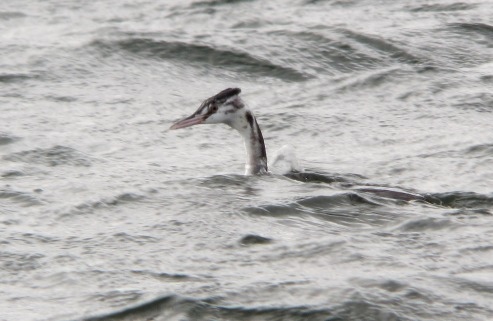
Also on the pond was the lingering first winter Great
Crested Grebe (See photo).
TUESDAY
NOVEMBER 19 - 2019
Nore
Barn
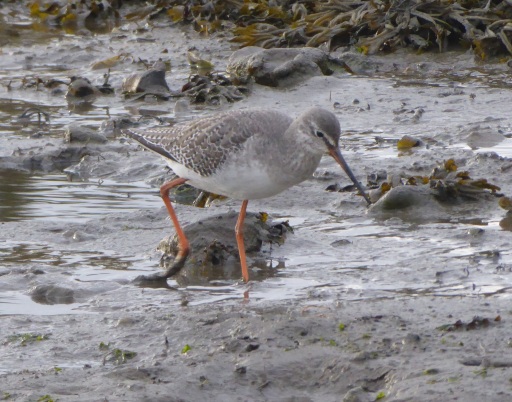
I went over to
Nore Barn this afternoon mainly to check on the
Spotted Redshank. The tide was well in when I arrived
and the stream full of tidal water. The Spotted
Redshank was the only bird present, getting its feet
muddy on the edge of the stream, close to where I was
standing. I gave him a little wave and I am sure I saw
a hint of a response from him. See you later!
For full history of
this astonishing bird go to . . . Spotted
Redshank at Nore Barn
Langstone
Mill Pond
Peter
Milinets-Raby reports . . .
I visited Langstone Mill Pond this morning for 90
minutes from 9:15am - low tide
Off shore feeding along the edge of the channel were
51 Teal, 26 Black-tailed Godwits, 89 Shelduck, 451
Dunlin, 12 Grey Plover, 8 Bar-tailed Godwits, 243
Brent Geese, 6 Red Breasted Mergansers, a Great
Crested Grebe, a single male Goldeneye, 20 Lapwing and
in the pond outlet stream was a Greenshank (un-ringed)
and sitting on the dark seaweed covered posts along
the stream was a male Kingfisher (see
photo).

On the mud were 3
resting Sandwich Terns and 4 Common Gull.
On the pond there was little to be seen, apart from
40+ Mallard, the family of Mute Swans, a Grey Heron, 2
Stock Doves, 2 Teal and a Great spotted Woodpecker.
Towards the paddock in the reed bed was a Stonechat.
In the paddock were 11 Moorhen and a Fox.
In the distance off Conigar Point were 207 Brent Geese
and 13 Red Breasted Mergansers. A bit
quiet.
SUNDAY
NOVEMBER 17 - 2019
Nore
Barn
When I arrived
at Nore Barn at about 12.30 this afternoon, the
Spotted Redshank was feeding at the top of the stream
by the bridge. It was so ridiculously close that I
just had to stop to take some photos and a video of
it. What a beautiful and extraordinary bird. No one is
going to tell me that this is not the same bird that
has been coming to this spot for the past 16 years and
behaving in exactly this manner.
Video clip of the
Spotted Redshank feeding . . . https://youtu.be/oaBmciPwwgI
Warblington
Peter
Milinets-Raby reports . . .
I was out this morning just after sunrise from 7:30am
to 9:30am. Low tide throughout. Warblington: In field
adjacent to the Black Barn along with a few cows were
4 Little Egrets and 3 Cattle Egrets (2 adults still
with a flush of orange on their crowns and a fist
winter/juvenile bird - almost certainly/probably the
birds I encountered on 21st and 22nd Oct and possibly
the ones at the pond on 9th Nov.)
Not a great deal about on the shoreline. I think I had
arrived after a Peregrine had been hunting, as I saw a
bird briefly sitting on the salt marsh, but it flew 20
metres and vanished from sight.
Off Conigar Point :16 Wigeon 117 Brent Geese1 Knot,2
Shelduck 1 Sandwich Tern east
The SSSI Field held 5 Meadow Pipits and a pair of
Stonechat. Off Pook Lane:7+ Grey Plover 219 Dunlin 161
Brent Geese 85 Shelduck (another good number, might
get into double figures again as the winter takes
hold!!) 21 Black-tailed Godwit 5 Bar-tailed Godwits 5
Red breasted Mergansers And 1 Sandwich Tern resting on
a buoy before it headed off east. A bit
quiet
WEDNESDAY
NOVEMBER 13 - 2019
Nore
Barn to Emsworth Harbour
Peter
Milinets-Raby reports . . .
"Perfect timing this morning for the Spotted Redshank
in the stream, but a bit too late and sunny for
everything else.
Nore Barn from 9:30am tide virtually in
In the stream was the Spotted Redshank (I had made
my mind up to walk straight passed and ignore it, BUT
it was soooo close, less than four metres away, so I
took a few photos. I just love the pose when it is
head on - such an elegant and slim wader - superb!
Also in the stream asleep was the Greenshank (G//R +
GL//- See photo) and actively feeding were 2 Dunlin.
I stood still for five
minutes for the Spotted Redshank, then along the edge
of the stream, less than 2 metres away, a Dunlin walks
nonchalantly passed me. Too much sun and in the wrong
direction, typical.

Also at Nore Barn were
53 Wigeon, 42 Teal, 232 Brent Geese and 14 Turnstone
perched on Buoys.
Beacon
Square:
At least two Skylarks passed over calling and 53 Brent
Geese
Emsworth
Harbour:
The Turnstone flew off from Nore Barn and tried to
settle on their favourite yacht in the harbour.
Sailors were trying to board the yachts, so the
Turnstone were disturbed and were loathing on the near
by Buoys. I counted 27 of them. Also present were 1
Little Grebe, 1 Canada Goose and a Kingfisher dashed
across the harbour and alighted on the wall at the
rear of the pond.
On the pond were 43 Coot and the first winter Great
Crested Grebe from the other day, along with a Great
Backed-Backed Gull.
Nore
Barn - 3pm
I also went to
Nore Barn this afternoon with the tide falling. The
Spotted Redshank was still in the stream along with
the colour-ringed Greenshank (G+GL) and one of the two
Dunlin seen by Peter earlier. The sun was low, but I
got a few shots to add to those of Peter's.
Peregrine?
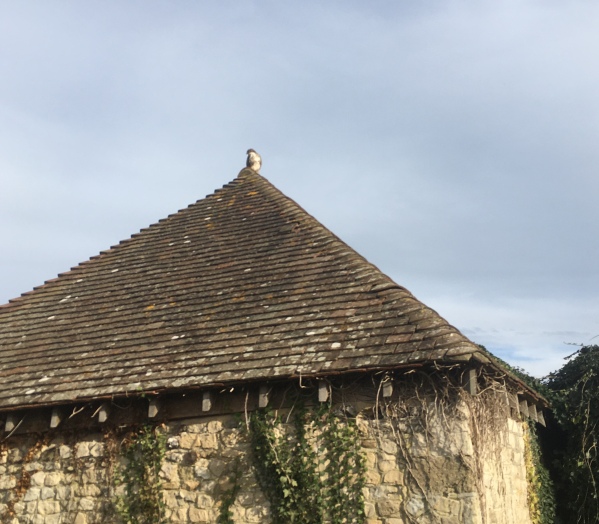
Rayner Piper's
aunt was visiting Emsworth today and took this photo
of what she thought might be a Peregrine on a barn
near Warblington church. That looks pretty good to me,
though I will see what others have to say. Peregrine
are occasionally seen in this area.
TUESDAY
NOVEMBER 12 - 2019
Langstone
Mill Pond
Peter
Milinets-Raby reports . . .
I was a bit late arriving at Langstone Mill Pond (from
9am) as the tide had virtually pushed in and only a
few birds were present. Just 2 Brent Geese, 4 Shelduck
and 5 Red breasted Mergansers!!!??!! On the last patch
of sea marsh were 2 Grey Plover, 48 Black-tailed
Godwit, 11 Lapwing and 2 Teal. Resting on one of the
rowing boats were 4 Sandwich Terns (one was a noisy,
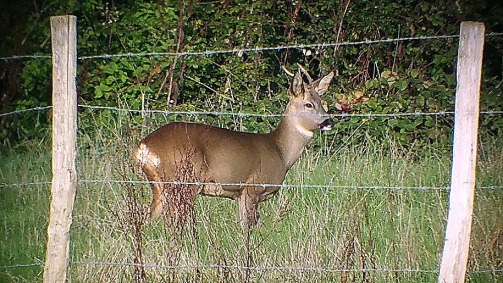
still begging juvenile).In the flooded horse paddock
were 11 Moorhen and a buck Roe Deer (see photo)On the
pond were 2 female Tufted Duck and 12 Teal, plus a
very mobile Kingfisher
SATURDAY
NOVEMBER 9 - 2019
Langstone
Mill Pond
Peter
Milinets-Raby reports . . .
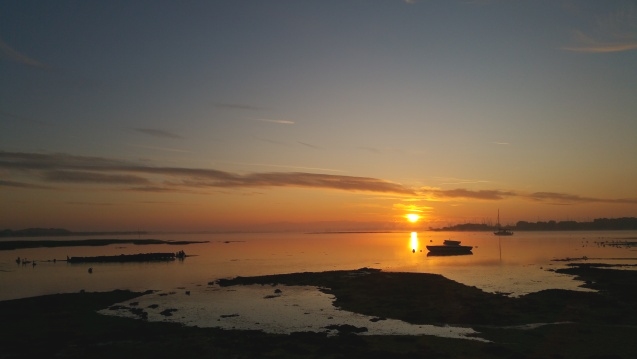
I was out this morning at the crack of dawn and before
the rain moved in. It was a wonderful morning. The
tide was coming in as I visited Langstone Mill Pond
from 7:10am to 8:38am.
Off shore were 60
Teal, 12 Wigeon, 130 Brent Geese, 1 Grey Plover and
flying over heading off to roost were a flock of 35+
Dunlin and 60+ Black-tailed Godwits.
On the pond resting were 3 Grey Herons, 2 Teal and 2
Cattle Egrets (an adult and a juvenile - see photo in
the rosy rays of the rising sun).

Also on the pond were
2 Reed Buntings, a tinkling flock of 65+ Goldfinch, a
single Siskin over and a Kingfisher.
As the tide pushed in a flock of 27 Lapwing flew off
from the fast disappearing salt marsh, a Great Crested
Grebe and a Red breasted Merganser were diving for
food and a Sandwich Tern rested on one of the rowing
boats.
FRIDAY
NOVEMBER 8 - 2019
Nore
Barn
Much as
yesterday, I got to Nore Barn on a falling tide at
11.15am and stayed for an hour. On arrival I found the
immediate harbour was occupied by a flock of 54 Brent
Geese gently honking away. What an evocative sound
that is.

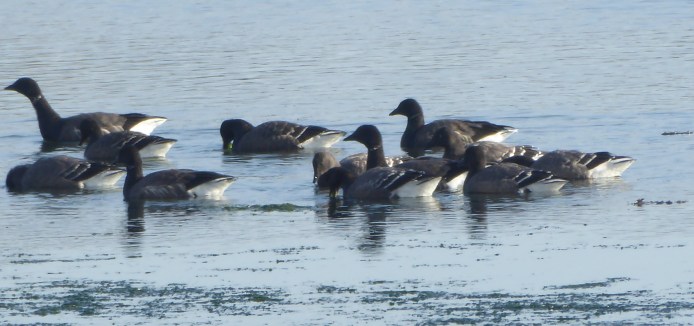
They included an
astonishing 17 juveniles. As the juveniles were all
mixed up, it was not possible to sort out families.
However, this number certainly suggests the Brents
have had a successful breeding season. The photo shows
a couple of families with three and four juveniles
respectively.
It will be interesting
to hear from other sources of counts in larger flocks.
The families in Emsworth Harbour always gravitate
towards the shores, so today's count will not
accurately represent the overall proportion of adults
to youngsters. But brilliant to see and hear!
Video clip of the
Brent Geese at Nore Barn . . . https://youtu.be/tUAcYQUyqAU
In the excitement over
the Brents, I almost forgot about the Spotted
Redshank and the colour-ringed Greenshank
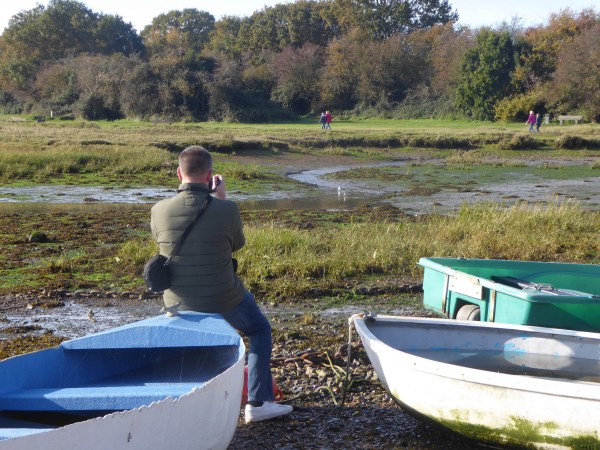
(G+GL) which were feeding happily in the stream. A
couple of visiting photographers were utterly
delighted to find these two birds so accessible; they
could not drag themselves away! I monitored the
photographers and am pleased to say they kept a
respectful distance from the feeding birds, as they
should!
Black-tailed
Godwits arrived in small groups from the east at
about 12 noon, settling down to feed on the shore with
the Brent Geese in the background. I counted a maximum
of 88 Godwits including three regular colour-ringed
birds: W+WN, G+WR and R+LG.

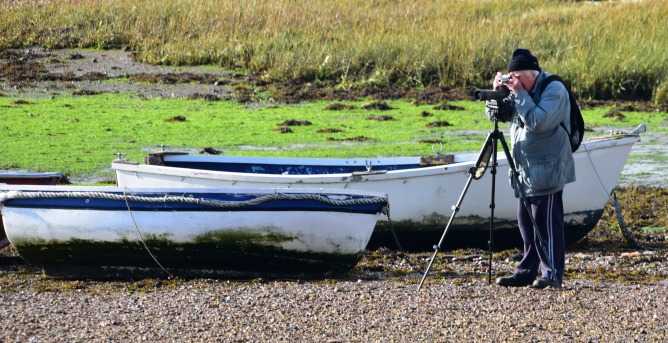
It was good to meet up
with Brian Lawrence who I have not seen for a long
time. Sadly, he told me that his wife had passed away
in he past year and he had just visited her grave in
Warblington Cemetery. Later Brian sent me some photos
of the bird stars of the show and one of me doing my
stuff!
Dead
swan
Brendan
Gibb-Gray reported the death of one of the pair of
Mute Swans that have nested on Peter Pond for several
years.
Brendan writes. . . "The
female of the Slipper Millpond pair of swans has sadly
passed away this morning in the reed bed outside my
patio window. What caused this is a mystery as she
shows no obvious sign of injury other than her neck
and head were lying in the water. The Cob was standing
by. All is rather sad and upsetting. Together they
have produced so many cygnets and this marks the end
of an era".
Here's a shot I got of
the pen swan in happier times with her 4 tiny cygnets
in May of this year. She subsequently lost one of the
cygnets, but the other three survived well.

THURSDAY
NOVEMBER 7 - 2019
Nore
Barn
I got to Nore
Barn at 10.30am on a falling tide and stayed for over
an hour. The Spotted Redshank and Greenshank (G+GL)
were already in the stream along with a Little
Egret.
It was good to meet Jo Bray who was especially pleased
to see the Spotted Redshank as it is featured in the
Bookends calendar for 2020 - available from her shop
in Emsworth.
When I arrived a group of around 30 Black-tailed
Godwits was assembled on the edge of the saltmarshes
snuggled up and waiting for the tide to recede.

During the next half
an hour more Black-tailed Godwits from the east joined
the flock on the edge of the saltmarshes swelling the
total to 96. I managed to find four colour-ringed
birds, all regulars in Emsworth this season: G+WR,
B+LG, W+WN and R+LG.
A Grey Plover was feeding on the emerging mudflats,
showing its typical stop and start feeding behaviour
and jet black eyes! Pity, we don't see these cracking
birds very often at this location.
Two Brent Goose families flew in one with three
juveniles and the other with two. I gather from other
reports that the Brent Geese appear to have had a
fairly good breeding season. Some years they have a
complete failure.
Wild
Bird populations in the UK 1970-2018
The latest
trend data on UK bird populations has been published
today. You can download the detail here:
https://assets.publishing.service.gov.uk/government/uploads/system/uploads/attachment_data/file/845012/UK_Wild_birds_1970-2018_final.pdf
Here is the press
release that went with it:
The Wild Bird Populations in the UK 1970-2018 report
is an annual stocktake of a suite of species groups,
termed 'indicators', of which farmland, woodland,
breeding wetland, wintering wetland and seabirds are
included.
The indicators are intended to broadly reflect the
environmental condition of different landscapes and
these are presented alongside an 'all species
indicator', which is made up of trends for 130
different widespread bird species. The 'all species'
indicator shows that over the long-term (1970-2018),
positives and negatives are balanced - with 29% of
species on the up and 28% experiencing decline. The
short-term trend, 2012-2017 delivers a similar story,
with 35% of those species increasing and 33%
decreasing.
It will come as no surprise that our farmland birds
are not doing very well at all but there are signs
of recovery here too. The long-term picture is still
pretty grim, with 62% of the species monitored, 19 in
all, showing a decline. However, the short-term
picture is more positive with 32% of farmland bird
species showing an increase in their populations, 42%
stable and 26% falling between 2012 and 2018.
Within the farmland group, Skylark, Corn Bunting, Reed
Bunting and Linnet populations have all shown
short-term increases and Tree Sparrow, Starling,
Lapwing and Kestrel have all remained stable over the
five-year period. Grey Partridge populations are still
in decline and showing no sign of recovery.
The woodland birds indicator is 30% lower than
it was in 1970; the short-term picture is not too good
either with more than half of the woodland birds
monitored, 37 species in all, showing declines. Even
here there are small glimmers of hope, the short-term
trend for Song Thrush showing a marked 22% increase
against a backdrop of long-term decline.
The trend for water and wetland birds reflects
the fortunes of 26 species, of which roughly a third
each are declining, stable and increasing. The Cetti's
Warbler has increased rapidly both over the long-term
and the short-term, whilst the Yellow Wagtail,
associated with wet grasslands, has shown a strong
decline for both time periods.
It's a bit of a rollercoaster for our seabirds
with 38% of the 13 species monitored declining
over the long-term but 46% increasing over the
short-term. Strong declines have been seen for both
Arctic Skua and Herring Gull populations over both the
long-term and short-term, whilst in the short-term
several species have shown a strong increase,
including Razorbill and Great Black-backed
Gull.
Thanks
to Keith Betton of Hampshire Ornithological Society
for the link.
WEDNESDAY
NOVEMBER 6 - 2019
Nore
Barn
Very much on
speck I stopped off at Nore Barn on my way home from
Chichester at about 1.15pm. The tide way out and I was
not expecting to see much, but what a lovely surprise
to find our two friends, Spotted Redshank and
colour-ringed Greenshank feeding happily together.
Peter Milinets-Raby also saw the Spotted Redshank at
low water yesterday, so clearly it is not restricted
to 2-3 hours either side of high water as it has been
in the past.
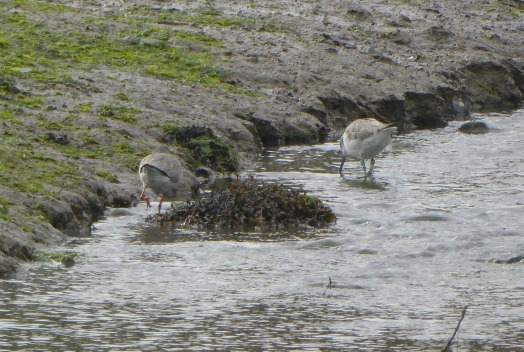
Here is a video clip
of the two birds showing their good companionship . .
. https://youtu.be/RN47FgHzJac
TUESDAY
NOVEMBER 5 - 2019
Emsworth
Harbour
Peter
Milinets-Raby visited the Emsworth shore this morning
for 90 minutes from 9:09am - tide going out,
His report follows.. . .
Beacon Square: 1 Grey Wagtail, 31 Brent Geese, 1 Grey
Plover, 16 Dunlin, 2 Turnstone, Redshank with colour
rings -//G + G//YG - a regular along this bit of
shore.
Emsworth Harbour: 14 Grey Plover, 20 Turnstone, 2
Knot, 353 Brent Geese, 267 Dunlin, 3 Little Egret. 2+
Skylark heard going over. 3 female Red Breasted
Merganser. 2 Little Grebe, 6 Shelduck.
Emsworth Millpond: 33 Coot and a Great Crested Grebe -
(see Nicola's photo below).
Nore Barn: 159 Brent Geese (This flock had 11
juveniles - four family groups). 15 Wigeon, 7
Shelduck, 3 Grey Plover.
Spotted Redshank in the stream on its own
showing really well down to five metres. It walked up
to me, recognised my woollen hat and I'm sure it then
winked at me! I managed to grab half a dozen photos
before it was rudely disturbed - see photos.
113 Black-tailed
Godwits - didn't manage to get any ring details as the
flock were flushed. They flew off east.
At 10:38a.m. everything, and I mean everything, flew
off as a couple of humans with a jeep from the
Chichester Harbour Conservancy pulled up on the
shingle and very noisily dragged a dingy across the
shingle and literally everything flew off! It was good
to hear the Spotted Redshank call as it flew off! With
an empty harbour, I then left!!
Spotted
Redshank
I went over to
Nore Barn at 3.15pm with the tide rising to high water
in a couple of hours. As Peter indicated in his
report, the Spotted Redshank was in typically good
form today, feeding happily at the top of the stream
near the bridge and winking a sweet 'hello' to
familiar figures - like Peter and me!! There is no
other Spotted Redshank that would feed this close nor
provide such a perfect photo opportunity with my
simple point and shoot camera .
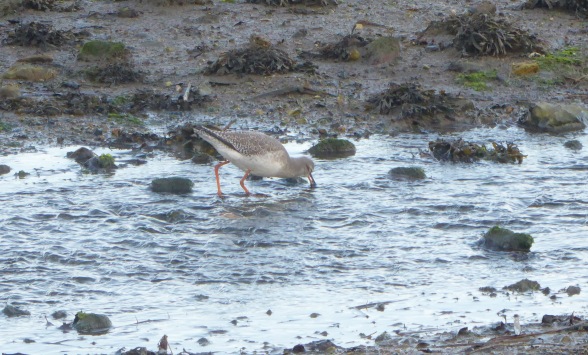
Here is a video clip I
took of this truly wonderful bird with.
https://youtu.be/qlPGGVQ9--I
Great
Crested Grebe
Nicola Hammond
sent me a fuzzy but clearly identifiable photo of the
Great Crested Grebe on Emsworth Millpond that featured
in Peter Milinets-Raby's report. This is the first
Great Crested Grebe of the year on the millpond. Last
seen on the millpond on 27-Mar-19.

TUESDAY
NOVEMBER 5 - 2019
Nore
Barn
I paid a quick
visit to Nore Barn at 3.15pm with the tide rising to
high water in a couple of hours. The Greenshank (G+GL)
was in the lower reaches of the stream, but the
Spotted Redshank was feeding happily at the top of the
stream near the bridge as is its custom, completely
oblivious to people passing nearby and providing me
with perfect photo opportunities with my simple point
and shoot camera.
Here is a video clip I
took of this truly wonderful bird. . . .
https://youtu.be/qlPGGVQ9--I
MONDAY
NOVEMBER 4 - 2019
Langstone
Mill Pond
Peter
Milinets-Raby visited Langstone-Mill-Pond-in-the-Rain
with an umbrella for 90 minutes from 9am. The
highlights were as follows. . . .
Off shore on the low tide mud were 21 Bar-tailed
Godwits, 246 Dunlin, 22 Lapwing, 14 Grey Plover, 4
Black-tailed Godwits, 154 Brent Geese, 44 Teal, 61
Shelduck, 3 Greenshanks, 3 Turnstone, 8 Sandwich Terns
resting, 11 Common Gulls, a single Knot and in the
channel were 25 Red-breasted Mergansers and 3 Great
Crested Grebes.
Off Conigar Point were a further 133 Brent Geese and
34 Lapwing.
On the pond were 40+ Goldfinch, 19 Teal and a single
juvenile Tufted Duck.
In the flooded paddock were 3 Teal, a male Pheasant
and 8 Moorhens.
Suddenly become busy. Winter is here
SUNDAY
NOVEMBER 3 - 2019
Brook
Meadow workday
A group of 9
volunteers assembled at the tool store on the Seagull
Lane patch at 9.30am for today's work session. The
weather was remarkably fine and calm after yesterday's
wind and rain.
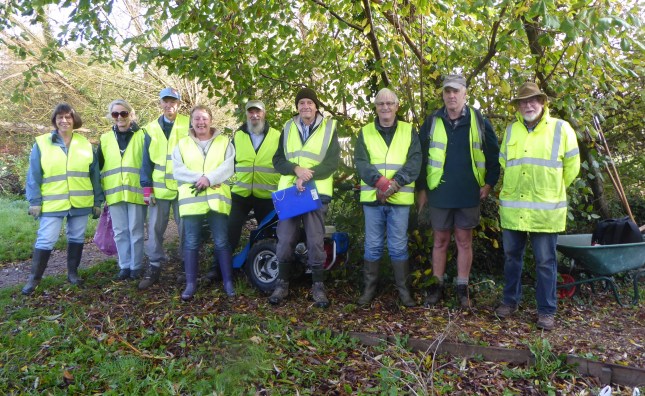
Colin Brotherston the
leader went through the main jobs for the day. (1) to
cut and clear as much as possible of the Lumley
area

(2) to tidy up the new
hedgerow and clear the ditch on the west side of the
Seagull Lane patch.

The area around the
cherry trees on the north meadow was also raked in
preparation for the Xmas decorations which will be
organised by Dan and Kathy.
There's not much in the way of wildlife news, but we
did spot a Red Admiral fluttering around. There were
lots of hungry Mosquitoes flying around. I got bitten
twice, but applied Anthisan immediately which is the
best remedy for me. Otherwise, I react badly.
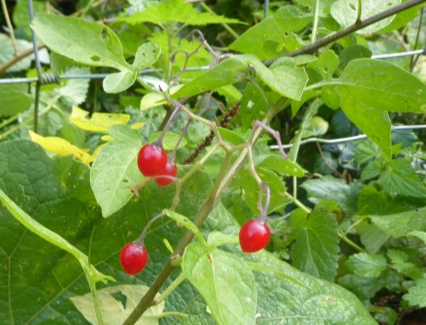
The volunteers clearing the ditch uncovered several
plants of Guernsey Fleabane and some Bittersweet with
berries.
For a fuller report
and more photos from the workday go to . . .
https://www.brookmeadow.org.uk/conservation-news/
Nore
Barn
I got to Nore
Barn at 12.45 with the tide rising to high water in
about 3 hours. When I arrived the Spotted Redshank was
resting on the mudflats near the saltmarshes to the
west of the stream.
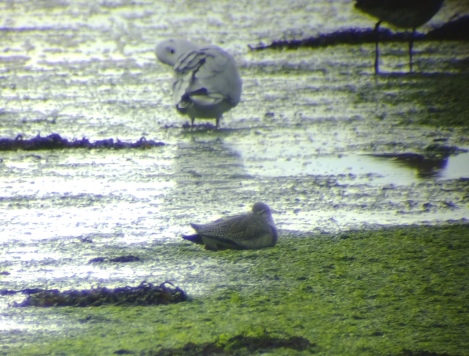
I made my way along
the shore south of the woods to view the flock of
Black-tailed Godwits that was starting to gather in
the creek. I counted a total of 124 Godwits which is a
new high for this season. Most of the Godwits were
feeding in water so I could not check them for rings,
but I did spot G+GL - a regular this season. The birds
were feeding actively with lots of spurting going on.
Do the ornithological authorities now accept that this
is common behaviour?

When I was about to
leave at 13.15 the Spotted Redshank had migrated to
the stream where it was being very closely watched by
a photographer with a huge lens camera.
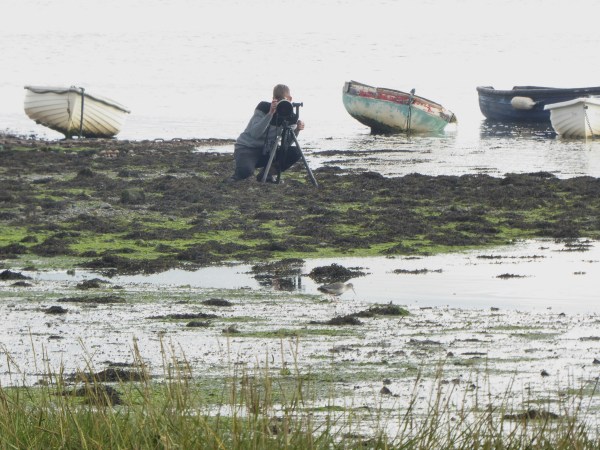
Having watched the
Spotted Redshank for the past 16 years, I know it is
unlikely to be fazed by the photographer's proximity,
but still it is not good practice to go that close and
risk disturbing this or any wild animal just to get a
photo. I have hundreds of decent photos of the famous
Spotted Redshank on this web site all taken with my
simple point and shoot camera at a reasonable
distance. It's a cinch! . . . Go to . . .
Spotted
Redshank at Nore Barn
Here is a poster that
is pinned to the fence at Nore Barn objecting to the
proposed extension of the raised walkway by Natural
England from the end of Warblington Road to include a
new bridge over the stream. Sheets of information are
available in a plastic folder giving lots of reasons
reasons why the route is unsuitable and a waste of
money.
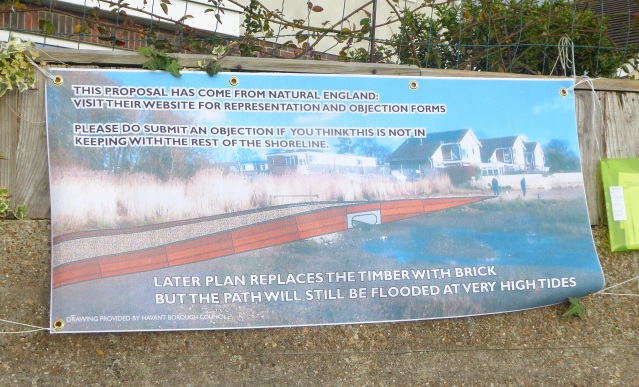
Personally, I think
the new walk way would be a neat solution to a badly
corroded footway which is parts is tricky to negotiate
and will only get worse if nothing is done. It would
also help to keep people and dogs away from the stream
where migrant birds regularly feed and are often
disturbed.
FRIDAY
NOVEMBER 1 - 2019
Nore
Barn
11.15 - 12.00
- Tide rising to high water in about 3 hours. Stream
filling. Weather cloudy, misty with a light breeze and
quite warm. Wigeon 72, Brent Geese 146. One Brent
family group with two juveniles that I did not see
yesterday.

Black-tailed Godwits
52 in the creek. They were all in shallow water up to
their bellies, so no opportunity to check for
colour-rings. Kingfisher flew across the Godwits
towards the stream.

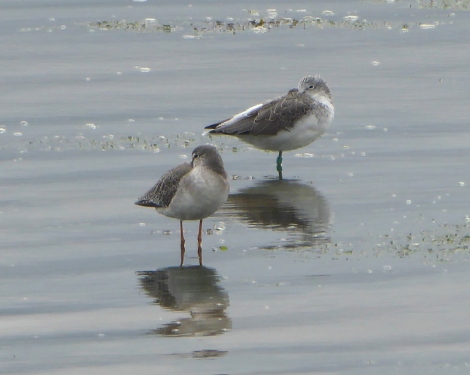
When I left just
before 12 noon the Spotted Redshank and colour-ringed
Greenshank (G+GL) were snoozing together on the edge
of the saltmarshes to the west of the
stream.
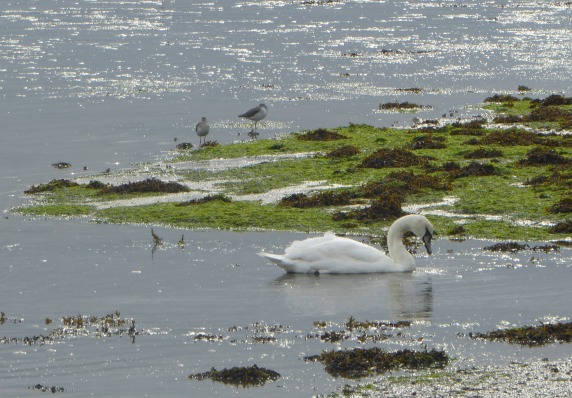
Friends reunited!
For
earlier entries go to . . . October
1-31