. .
MONDAY
APRIL 15 - 2019
Bridge
Road Wayside
I counted
59 Cuckooflowers on the wayside this morning,
mostly fully in flower. I expect there are more to
come. It will be interesting if we can top last year's
total of 157 on 21-Apr-18. We are unlikely to get
anywhere near the record number of Cuckooflowers for
this wayside which was 694 in 2012 (by 15 April).

There are lots of
Cow Parsley plants on the wayside, some already
in bud with open flowers, but many more to come. It is
a fine sight when they are all in flower.
Palmer's
Road Copse
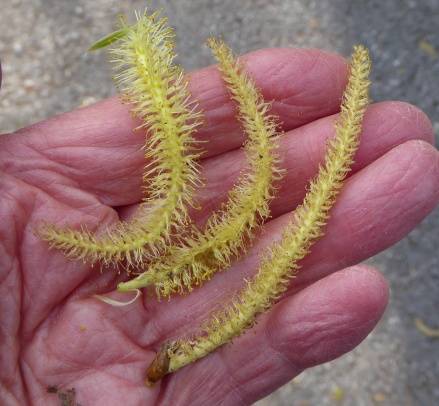
Long yellow
curled catkins from the tall Basford Willows
are now falling onto the ground at the southern end of
the car park.

You can pick them up
in handfuls, though many are squashed by the passing
cars.
Newly flowering on the
west bank of the river immediately below the
observation fence were Herb-Robert and
Garlic Mustard.
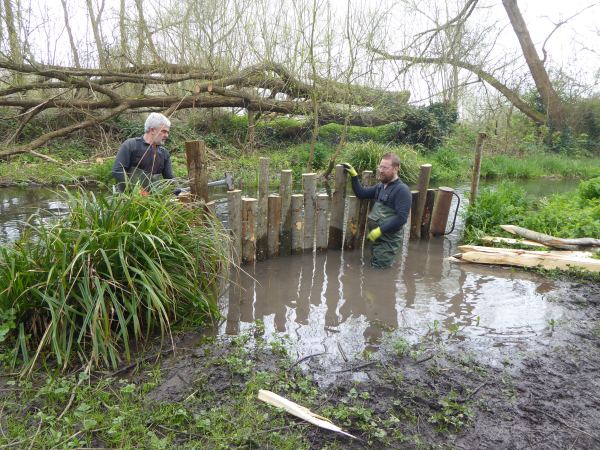
I counted 30 posts
hammered into the west bank to reinforce the river
bank where it encroaches onto the main path though
Palmer's Road Copse.

I got a shot of the
two chaps doing the work on April 8th.
Two Alder
saplings (?) protected by plastic tubes have been
planted near the path through the copse where the
undergrowth has been cleared.

Maurice Lillie
informed me that they planted five Alders in Palmer's
Road Copse, two are, as you say fairly close to the
muddy path, the other three to the west of them in the
wet dip about halfway towards the car park.
Cetti's
Warbler
Our 'resident'
Cetti's Warbler was blasting out his 'cetti ...
cetti ...' song from the dense undergrowth in Palmer's
Road Copse. I heard it sing four times as I walked
along the main path through the copse. You can't
mistake it for any other bird as it is so loud! This
was my 4th hearing Cetti's Warbler in Palmer's Road
Copse this spring which indicates a male singing to
establish territory and attract a mate. Let's hope it
succeeds and so establish it as a breeding bird for
Brook Meadow. That would be a first for Palmer's Road
Copse. Though very easy to hear, Cetti's Warbler is a
notoriously difficult bird to see let alone
photograph. I offer a challenge to a keen wildlife
photographer to get a photo of this elusive bird. I
waited and looked closely today, but saw nothing.
However, here is a nice shot of one that Tony Wootton
got several years ago.

Cetti's Warblers are
not exactly rare birds, but very nice to have on Brook
Meadow. They are fairly common down on North Thorney
and we have had a fairly regular spring Cetti's
Warbler over the years to Peter Pond and the Lumley
Stream area of Brook Meadow, though we missed out
completely last year. Our best year was 2010 when one
was regularly heard and seen from April through to
June and even photographed - as by Tony
above!
Hermitage
Millponds
The Mute Swan
was snug on her nest in the reeds on Peter Pond.
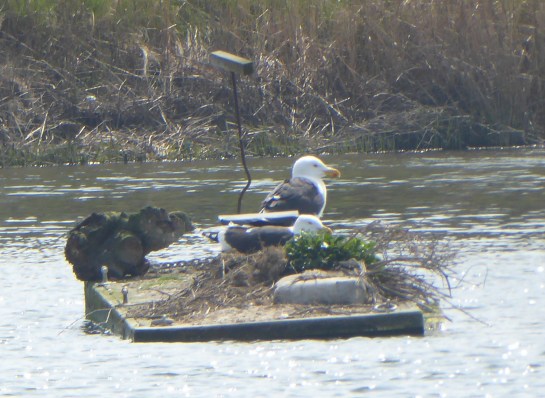
All was peaceful over on Slipper Millpond where the
Canada Goose was on its nest on the large centre raft
with its mate standing on the north raft nearby and
the pair of Great Black-backed Gulls was on the south
raft with one sitting on a nest.
Lillywhite's
patch
Some more
clearance work has taken place on the area of ground
immediately to the south of Gooseberry Cottage and to
the east of Peter Pond. The clearance is mostly of
bramble bushes from what I could see, though this is
not the best time of year to undergo scrub clearance
with birds possibly nesting. This land used to be
owned by Lillywhite's Garage - hence the name I have
given the site. But I gather there is a new owner who
might be interested in developing the land. I will
keep an eye on it.

Warblington
wonder!
Peter
Milinets-Raby was out early this morning arriving at
Castle Farm Warblington just after sunrise at 6:30am
for a two hour walk. In the fields off the northern
arm of Pook Lane were 7 Med Gulls, a male Pheasant, 3
Song Thrush, plus 4 Little Egrets, a single House
Martin over and a singing Chiffchaff.
The Ibis Field held 2 further singing Chiffchaff, plus
a singing Blackcap, a single Moorhen, 2 male Pheasant
and 2 Mediterranean Gulls in with 60+ Black Headed
Gulls.
In the field behind Conigar Point were a small flock
of 26 Linnets and a singing Skylark.
And at 7am , flying
east over the winter wheat field was a male Montagu
Harrier. In view for 10 seconds or so before it
dropped below the hedge line then popped up briefly
over towards Nore Barn Wood before sailing away into
the rising sun! A true Warblington Wonder, but alas
the sighting was over too quickly.
The tide was pushing
in to full and at Conigar Point I observed 10
Shelduck, a single Canada Goose heading east, 8
Mediterranean Gulls over and a Cetti's Warbler was
heard singing from the mini reed bed.
Off Pook Lane there was a noisy resting flock of 76
Mediterranean Gulls. Apart from three winter
types, they were all adults.

Also off Pook Lane
(tide nearly in) were 5 Canada Geese, 8 Shelduck, a
pair of Red Breasted Merganser, a single Brent Goose
and a Great Crested Grebe.
Not much happening at Langstone Mill Pond due to the
brisk wind, except for a pair of Tufted Duck, 5 Teal,
a singing Blackcap and a calling Reed
Bunting.
Insect
Workshops by Bryan Pinchen at Portsmouth Museum
Note from
Christine Taylor Curator of Natural History
I am pleased to offer
three insect identification workshops at Portsmouth
Museum this year. The workshops are suitable for
adults aged 18 and over and ideal for beginners and
those looking to improve their insect identification
skills.
They will all be led by Bryan Pinchen,
consultant entomologist and author.
Each workshop will run from 10am - 4pm - please note
that the Bumblebee and Grasshopper workshops will move
to Portsdown Hill in the afternoon. Coffee and Tea
will be provided, please bring a packed lunch. Cost
£25 or £15 with Portsmouth Leisure Card.
Advance booking on 02392 834744 essential,
there are only 20 places on each workshop
available.
Garden Insects 11
May 2019
Even the smallest garden is visited by a number of
insect species. Learn how to identify the different
insect groups and how they differ from each other. The
afternoon will be spent hunting for insects in the
garden of the museum and using newly acquired
identification skills. Venue: Portsmouth Museum,
Museum Road, Portsmouth.
Bumblebees 8 June
2019
Most people are familiar with bumblebees as
several species visit gardens. Learn how to separate
bumblebees from similar looking insects and how to
identify the 24 species found in Britain. The
afternoon will be spent on Portsdown Hill looking at
bumblebees in the field and applying the
identification techniques learnt in the morning.
Venue: Portsmouth Museum (am) Portsdown Hill (pm)
Crickets and
Grasshoppers 27 July 2019
Learn how to identify different species of
grasshoppers and crickets in this one day workshop
through talks and exercises using specimens from the
museum's and tutor's collection. The afternoon will be
spent on Portsdown Hill looking at grasshoppers and
crickets in the field and applying the identification
techniques learnt in the morning.
For further details
(not booking) please contact me Christine.taylor@portsmouthcc.gov.uk
FRIDAY
APRIL 12 - 2019
Brook
Meadow
Three-cornered
Garlic is flowering in the usual spot, just
outside the Seagull Lane gate. It is similar to Summer
Snowflake, but has the slightly different petals with
green lines, not green tips.

The buds on the young
Oaks on the Seagull Lane patch are bursting and
will be in full leaf very soon. The more mature Oak on
the east side of the north meadow is leafing and
flowering. Oaks generally are now in full leaf.

I am a bit concerned
about the very large Ash tree on the railway
embankment which overhangs the north river. It usually
has a good crop of red flowers at this time of the
year that come before the leaves, but there is no sign
of life of any sort on it. Could it have Ash die back?

There is an Ash
sapling a little way along the north path that does
have a healthy crop of leaves.
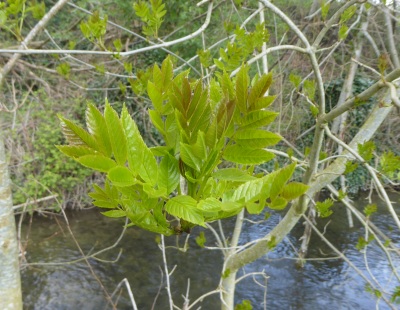
In sharp contrast, the
Rowans on the Gwynne Johnson plantation on the
east side of the north meadow are looking very good
with new leaves and flower buds in abundance.

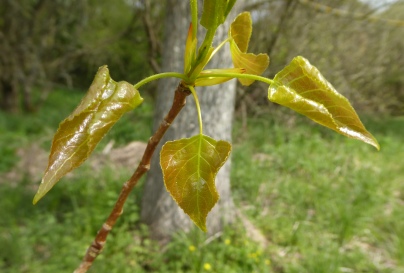
The tall Black
Poplars are also sprouting leaves for the first
time.
I will need to check them from time to time to
determine the hybrid species - possibly Florence
Biondi.
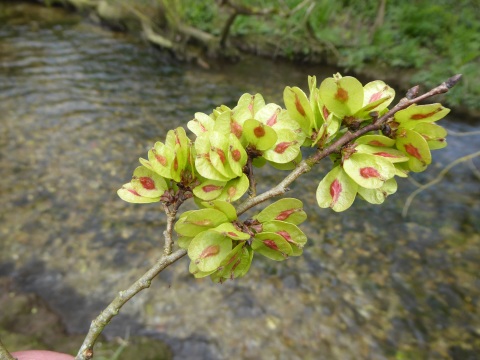
One of the young and
dying Elms on the edge of the Lumley Stream
has made a last push for life in producing a crop of
fruits.
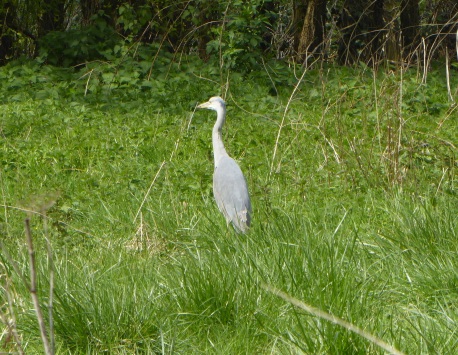
The regular Grey Heron
was walking around the north meadow while I was
there.
Woodlouse
spider
This afternoon
my wife came across an interesting spider lurking in
the garden shed. It is certainly not the regular
Garden Spider or one I was readily familiar with.
However, it is quite distinctive in appearance having
a bright reddish brown thorax (called carapace in
spiders), red legs and a plain pale oval shaped
abdomen. I brought it inside for a photo then released
it back in its 'home'.

I think I found the
right identification in my field guide ('Britain's
Spiders' by Bee, Oxford and Smith) as Dsydera
crocata - described as widespread in much of
Southern England, particularly near the coast. It
feeds almost exclusively on woodlice, hence its common
name.
Correction
on the hoverfly
I am very
grateful to Bryan Pinchen for pointing out that my
tentative 'Eristalis' ID from in the blog for Sunday
April 7th is actually a solitary bee, genus
Andrena Here is my original photo of the
insect

Bryan added .. . .
"if
it was an Eristalis (or any other hoverfly) you
wouldn't be able to notice the antennae sticking out
the front of the head like you can on your specimen.
Hoverflies and a good many other flies only have three
antennae segments and these typically hang down the
front of the face making them often impossible to see
from above. Bees (and wasps) have 12 or 13 antennae
segments and these can early always be seen protruding
from the front of the head."
Here is an
Andrena bee (Andrena nitida) taken from
the internet

Extra note . . .
Andrena Bee is commonly called the mining bee. In
temperate areas, Andrena bees (both males and females)
emerge from the underground cells where their prepupae
spend the winter, when the temperature ranges from
about 20 °C to 30 °C. They mate, and the
females then seek sites for their nest burrows, where
they construct small cells containing a ball of pollen
mixed with nectar, upon which an egg is laid, before
each cell is sealed.
Bryan added . . .
Mining bees are different to carpenter bees,
the only carpenters we get in this country are an
occasional visitor, which has bred, in the genus
Xylocopa. Most of the commonest mining bees we have
are in the genera Andrena and Lasioglossum.
THURSDAY
APRIL 11 - 2019
Millpond
nesting news
All was peace
and quiet when I walked round Slipper Millpond this
morning. The Canada Goose was on its nest on
the large centre raft, though not all that easy to
see.
I was a little surprised to see its mate standing on
the south raft, seemingly watching over one of
Great Black-backed Gulls which was sitting on a
nest at the other end of the raft.
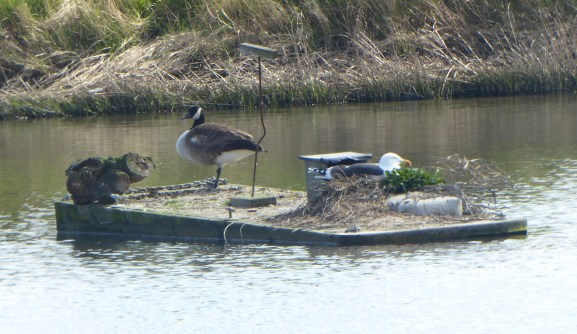
The two gulls changed
over their nest sitting duties while I was there but
the Canada Goose remained unmoved. I continue to be
amazed at the dominance that the Canada Geese appear
to exert over the Great Black-backed Gulls.
]

Also, while I was
present the cob swan from the Peter Pond pair swam
past the raft, but it just sailed past! It seems as if
all three nesting pairs have come to accept each
other's presence. Here is a video clip on the incident
. . . https://youtu.be/4U4JCei-HR8
Meanwhile, the
pen Swan was tending to her nest in the reeds on Peter
Pond.

My first 'May' blossom
of the year is out on a Hawthorn bush on the south
side of Peter Pond next to the main road.

Finally, coming back
through Brook Meadow I stopped to watch the fluffy
seeds being blown from the Bulrush spikes by the brisk
wind.

WEDNESDAY
APRIL 10 - 2019
Bluebells
and more
I popped into
Ashling Wood on the way back from Chichester this
afternoon and was rewarded with a glorious display of
Bluebells. They are now at their best.

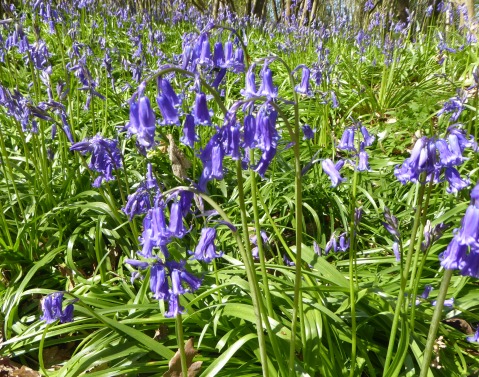
I also called into
Hollybank Woods where the Bluebells have some way to
go to catch up with Ashling Wood. They are always
behind at Hollybank, so give them another week or two.
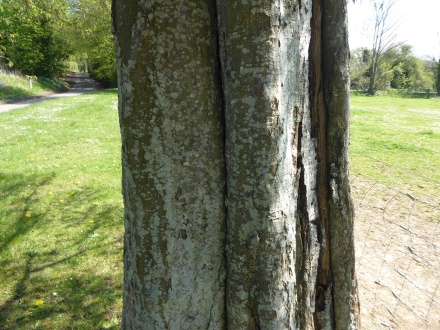
I stopped at Woodend
to have a close look at the Grey Poplars which
are now leafing on top of the catkins.


Here is the grey bark
from which the tree gets its popular name.
I went on to Marlpit
Lane where I had a mooch around the weedy area at the
far end of the restoration area which has a glorious
mixture of wild and not so wild plants, including
Common Stork's-bill, Cornsalad, lots of Forget-me-nots
and a Pot Marigold.
MONDAY
APRIL 8 - 2019
Langstone
Mill Pond
Peter
Milinets-Raby got up with the sun and went down
Langstone Mill Pond for a couple of hours from 6:40am
to 8:40am - very low tide, just a trickle, but alas
with two bait diggers there was lots of disturbance
and very few birds.
On the pond were two pairs of Tufted Duck (see photo),
a pair of Reed Buntings (male occasionally singing,
but calling loads - see photos), singing Blackcap,
Chiffchaff and Stock Doves. Five Little Egrets sat on
nests with 4 more in the trees displaying with
wonderful guttural bubbly calls - great
sound!
Nest 11 of the Grey
Heron colony has three tiny young, seen fairly well
when the adult flew in the feed them several
times.
Loads of movement of Med Gulls going inland and coming
back. At one point I had a flock of 46 pass over.
Off shore were 3 Teal, 1 Greenshank, 15 Black-tailed
Godwit, a single Shelduck and 3 Canada Geese flew over
honking and headed east towards Thorney Island..
In the horse paddock were 5 Moorhens, 2 Jays, 3
Linnets and a male Pheasant.
SUNDAY
APRIL 7 - 2019
Brook
Meadow - Work session
It was a fine
spring morning for today's regular 1st Sunday in the
month work session on Brook Meadow led by Mike Probert
and attended by 8 volunteers (not including me, the
photographer).

The main task for the
group was to build a temporary twig fence around the
main wild flower area on the north meadow to prevent
undue trampling of orchids and other flowers that grow
there. Notices were installed around the edge of the
area asking walkers to keep clear.

Meanwhile, Dan and
Terry set about strimming the nettles on the river
bank and tending to the newly planted Common Reeds.

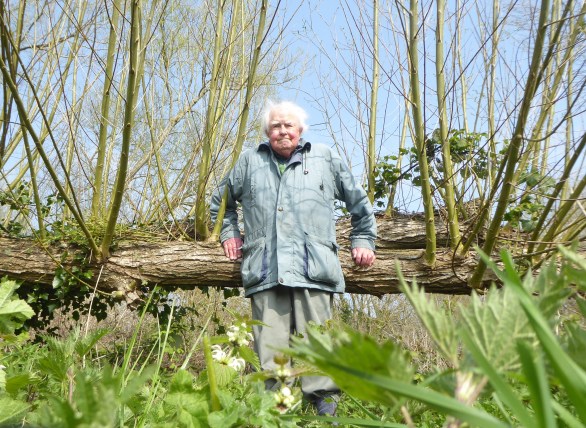
I was grateful to
volunteers for clearing a gap on the fallen Willow for
me to lean against.
The full report and
more photos is on the Brook Meadow site at . . .
https://www.brookmeadow.org.uk/conservation-news/
Wildlife
observations
I heard at
least three Blackcaps and two Chiffchaffs singing in
different areas of the meadow. Whitethroats will be
here in a week or so. During coffee time we all had a
good view of a Buzzard soaring over the meadow
which I lucky enough to get a half-decent photo of.

The first Orange
Tip of the year on Brook Meadow was flying on the
river bank as Dan and Terry were strimming. It was
attracted to the what is the first Cuckooflower of the
year on the meadow and I managed to get a shot of the
insect feeding on the flowers. The photo shows well
the green mottled underwings of the insect.

The leaf buds are
almost bursting on the Oak saplings on the Seagull
Lane patch.

Both Divided
Sedge and Distant Sedge are both showing
well on the Lumley area.
The brown spikes of
Greater Pond Sedge and Lesser Pond Sedge are also out
on the Lumley area and the River Ems respectively.
Leaves of Hard Rush are showing well on the orchid
area and Sharp-flowered Rush is abundant on the Lumley
area. The attractive leaves of Silverweed are now
widespread over the Lumley area.

One of the volunteers
Geoffrey showed me some fungi that he noticed growing
in crust-like fashion on one of the dead logs he was
moving in the trolley. A Google search led me to
so-called Crust (or Corticioid) Fungi which
typically grow on dead logs. My very tentative
identification is Peniphora quercina -
which Phillips (Mushrooms p. 240) says is common on
dead deciduous trees.
Later Geoffrey also
called me over to see some a cluster of tiny bright
blue beetles on the west side of the north meadow.
These are Flea Beetles (Altica
lythri) which we see regularly on Brook Meadow
in early spring. I was able to demonstrate their famed
ability to jump when touched, a sure way of
identifying this small creature.

I spotted a hoverfly
with ginger hairs feeding on a Dandelion flower which
I have tentatively identified as an Eristalis
species which are Honey Bee mimics.
Correction
on the hoverfly
I am very
grateful to Bryan Pinchen for pointing out that my
tentative 'Eristalis' ID from in the blog for Sunday
April 7th is actually a solitary bee, genus
Andrena Here is an Andrena bee
(Andrena nitida) taken from the
internet
SATURDAY
APRIL 6 - 2019
Emsworth
Millpond
Jean and I
walked round the millpond this morning on our way to
the shops. There was no sign of the Coot nesting
raft that Nicola Hammond saw and photographed on
April 1st. What has happened to it?
Nothing special on the pond, though I did spot the
first drooping spikes of Barren Brome grass on
the Bath Road grass verge.
Waysides
News
I had a walk
around some of the local waysides this afternoon.
Starting at Bridge Road Wayside I counted 27
Cuckooflowers in flower so far, with more to come I
hope.
A small fly was feeding on one of the Cuckooflowers.
It looks a bit like the Yellow Dung-fly that I
saw yesterday on cow dung in the Westbourne fields.
Apparently it does take nectar as well as animal prey.
Corrections are welcome, of course!

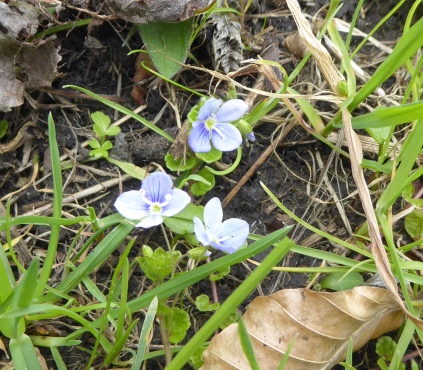
Slender
Speedwell was among the other flowering plants
that I noted on the wayside.
I had a quick look at the Railway Wayside north of
Emsworth Railway Station. The site is getting
overgrown and the fencing between the wayside and the
adjoining Highways Agency track has largely come down
- just fallen or pulled?

As for the wayside
itself, the embankment, of which we had such high
hopes when it was first constructed, is now very
overgrown. I looked in vain for any sign of Coltsfoot
which has always flowered on this site.
However, I did see my first male Orange Tip
butterfly of the year quartering back and forth along
the Highways Agency track, but never stopping. A
beautiful Peacock butterfly was far more
obliging, coming to rest on the ground very close to
me.

The Highways track
between the railway and the A27 road has been cleared
right down to the gates that open out to the path from
the end of Washington Road. I walked part of the way,
but there was nothing to see at the present, but it
could be promising. I will keep an eye on it.

Emsworth
- Warblington
Peter
Milinets-Raby ventured out early this morning starting
as the sun rose at 6:30am. It was low tide. His report
follows . . . .
Beacon Square: 2 Great Crested Grebes and a Med
Gull.
Nore Barn: 2 Little Egrets.
Emsworth harbour: 25 Shelduck, 2 Teal, 3 Greenshank
(RG//- + YB//-), 23 Mute Swan, 2 Canada Geese that
slowly wandered out into the harbour, 43 Med Gulls, a
pair of Red Breasted Merganser, 1 Lesser Black-backed
Gull.
Warblington: (7:40am to 8:40am). 17 Med Gulls feeding
in the fields west of the cemetery
a pair of Pheasant, 4 Stock Dove. 1 singing
Chiffchaff.
Conigar Point: 6 Shelduck and a single Black-tailed
Godwit.
Off Pook Lane: 11 Shelduck, 1 lone Brent Geese, 36
Black-tailed Godwit (I had 136 yesterday), a pair of
Red Breasted Merganser, 1 Teal.
FRIDAY
APRIL 4 - 2019
Westbourne
fields
I had a
nostalgic walk through the fields towards Westbourne
this morning, nostalgic because my wife and I lived
for over 30 years in one of the large Edwardian houses
in Westbourne Avenue which back onto the fields. The
fields provided my first encounter with the natural
world and became the perfect playground for our four
children. Just hop over the wall and they were in the
countryside! That was over 20 years ago and now the
fields are threatened with housing development. But we
can't be selfish, people must live somewhere and there
is no nicer place to live than here. So I wish the new
residents well though the old residents will not thank
me for saying this!
Here is a view of the fields looking north towards
Westbourne - you can just see the top of the church
steeple. The remains of two old Oak trees are on the
ground and a fresh sapling (not an Oak).

There was quite a lot
of cow dung in the fields, though I did not see any
animals during my walk. Maybe they were hiding. There
were lots of Yellow Dung-flies on the more
runny dung mounds, many apparently in the act of
mating. I gather the flies do not actually eat the
dung, but are mostly predators of smaller insects
which land on the dung. The dung is used for breeding;
females lay eggs on the dung which hatch into larvae
after a couple of days. The larvae then burrow into
the dung for protection and feed on it. They then
burrow into the soil around the dung to pupate and
finally juvenile flies emerge to complete the cycle.

I could not resist
having a quick look over the wall into my old garden
where things had not changed all that much. Just near
the wall I discovered my first buttercup flower of the
year. From the reflexed sepals I would think it was a
Bulbous Buttercup, which is usually the
earliest of the buttercups and is the most common of
the buttercups in these fields.

The only other notable
floral feature in the fields were several splendid
clumps of Red Dead-nettles. I was interested to
read that Red Dead-nettle is the most widespread of
the archaeophytes (ie ancient introductions - before
1500) in this genus and is common in cultivated ground
throughout the country.

The entrance (and
exit) to fields is quite dramatic as you need to go
through a subway under the A27 road which is covered
in bold and colourful graffiti. Here are a few
examples on the subway walls.

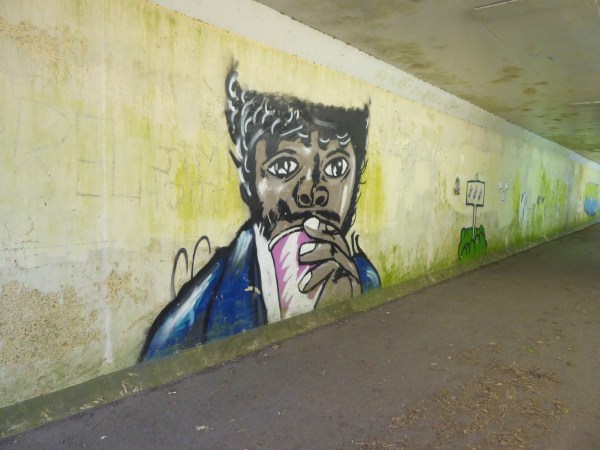
Finally, a message
from the artist to carry with us as we make our
way!

WEDNESDAY
APRIL 3 - 2019
First
Swallow
Susan Kelly
has the honour of having seen the first Swallow of the
summer over the town millpond today - though hardly
with summer temperatures. Here's a nice image from
last summer caught by Derek Mills.

Sparrowhawk
Christopher
Evans's bird of the day was a juvenile Sparrowhawk
sitting up in a tree, at the point just north of
Southmoor where a track goes right towards The
Mallards.

Woodpigeon
- top garden bird
The BTO
reports that, for the first time ever, Woodpigeon has
reached the number 1 spot in the annual results in the
Garden BirdWatch scheme. Their presence has been
rising steadily since the beginning of the scheme in
1995 when just 60.8% of gardens recorded Woodpigeons.
By 2018 this figure had increased to 92.8%.

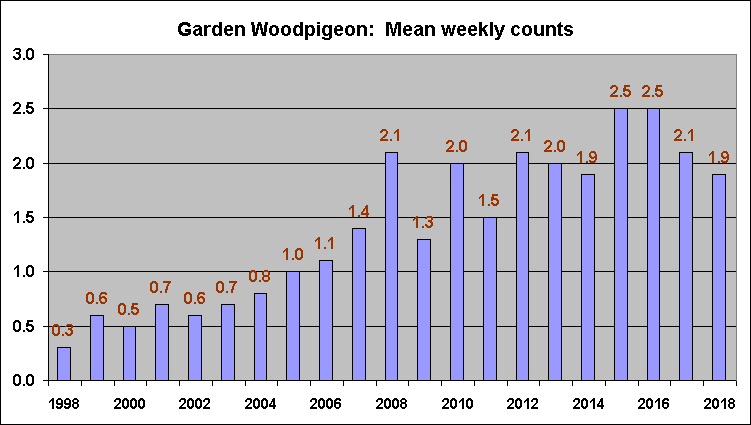
This increase in
garden Woodpigeons since the 1990s as noted by BTO is
also present in my own garden as the following chart
demonstrates, though there has been some hints of a
decline over the past couple of years.
TUESDAY
APRIL 2 - 2019
Langstone
Mill Pond
Peter
Milinets-Raby managed to get an hour at Langstone in
this morning before the rain passed through (9am to
10:16am) - tide slowly coming in, which was just as
well it was slowly coming in as a delivery truck was
stuck in the mud outside the Royal Oak pub (apparently
since 8am!). By the time I left, it had been rescued
and the water was lapping into and around the huge
gouge ruts left by the wheels. A close shave for the
driver!

Peter's departure was
delayed by 15 minutes when in quick succession he had
two little flocks of Meadow Pipits pass over heading
north, obviously moving ahead of the lead grey rain
clouds trundling in from the north west. In a quarter
of an hour he had a total of 47 Meadow Pipits and
moving over with them were 1 Swallow and 1 Sand Martin
(Both firsts of the year).
Langstone Mill Pond
was busy with Little Egret activity, with 17 birds
present. Five of them were already sat on nests!!
There was no change in the Grey Heron colony.
Elsewhere on the pond were a pair of Tufted Duck, a
Blackcap singing from the rear, a Chiffchaff singing,
a male Reed Bunting calling and occasionally singing
and a Sparrowhawk dashed over.
Off shore on the last
bit of salt marsh were 12 Brent Geese, 8 Teal, 55
Black-tailed Godwits (Only about 8 Redshank left), 3
Shelduck, 9+ Med Gulls passing over and 3 Red Breasted
Merganser.
Even
earlier ducklings
Last Wednesday
Jo Bray spotted a Mallard with a family of 11
ducklings in the stream leading down to Mill Lane
(opposite the church) in Westbourne! These are the
first of the year?

Westbourne
Wildlife Watch
I have
received a press release from John Millard announcing
a new campaign based in nearby Westbourne, called
Westbourne Wildlife Watch, which aims to encourage
local people to report wildlife sightings, which can
be used as evidence to protect local habitats. The
campaign is organised by the local environmental group
called 'Greening Westbourne' which I think is based
mainly at Hampshire Farm Meadows. For more details go
to . . . https://e-voice.org.uk/greening-westbourne/report-wildlife-sightings-and/
Observers are
encouraged to record wildlife by using the online
facility iRecord . . . https://www.brc.ac.uk/irecord/
It will be interesting to see how it develops, but
anything that gets people interested in recording and
protecting wildlife must be a good thing. I shall, of
course, be happy to report any interesting wildlife
news on this Emsworth blog which also covers
Westbourne.
MONDAY
APRIL 1 - 2019
Slipper
Millpond
Normal service
appears to have been resumed on Slipper Millpond.
The Canada
Goose is snug on its nest on the centre raft
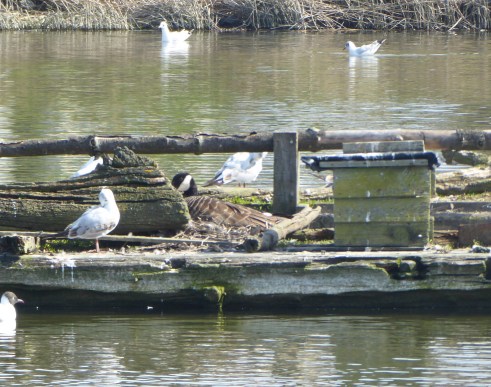
and the Great
Black-backed Gulls have returned to the south
raft
where there is a good supply of nesting material.

Basford
Willows
The tall
willows on the southern edge of Palmer's Road Car Park
are now decorated with thousands of bright yellow
catkins.

Many catkins are
already falling to the ground and will soon be
covering that area of the car park. This is an annual
phenomenon which is really quite spectacular.

Brook
Meadow
Coming back
through the meadow I heard three Blackcaps
singing, one in Palmer's Road Copse, one near the
Lumley gate and a new one from the brambles in the
north of the Seagull Lane patch. I was also pleased to
hear what has now become a regular Cetti's
Warbler in Palmer's Road Copse. Will it breed
here?
The first brown
spikes of Greater Pond Sedge are now out on the
edge of the Lumley area near the stream.

Another Small
Tortoiseshell butterfly was flying near the north
bridge and settled for a photo - the second I have
seen on the meadow in the past week. A good omen.

Raft
on town millpond
On passing the
town millpond this afternoon Nicola Hammond saw a new
nesting raft which had been positioned on the
Bridgefoot Path side of the pond towards the bridge. I
am sure the local Coots will appreciate this as they
have never been able to nest successfully on the
millpond. Let's see how they get on.

Mallard
ducklings
Christopher
Evans spotted the first Mallard ducklings of the year
- 7 of them - on Hilsea Lines today.

Warblington
Peter
Milinets-Raby spent an hour walking around Warblington
and along the shore (9am to 10:07am - high tide).
There was very little to report.
Ibis Field: 2 singing Chiffchaff
Hay dump: Just 2 Pied Wagtails and another Wheatear
(see photo). Skylark singing in the
distance

The Linnet flock was
back to its 200+ numbers and very mobile swirling over
the stubble field and occasionally landing on the
nearby trees. I could not find anything in the flock,
except Linnets.
A Cetti's Warbler sang briefly from the mini reed bed
behind Conigar Point
From Conigar Point were 4 Teal, 2 Shelduck, 2 Brent
Geese, 4 Med Gulls and 2 Great Black-backed
Gulls
For
the previous entries go to . . March
16-31


